Menu
Please view on a larger device for optimal experience.
Go back
Home
Other projects
About me
CityStream - a Civic tech platform
Product & design operations
Product & design strategy
·
Design lead
·
................
Overview
CityStream is a pre-seed Bay Area start up, modernising local government administrative processes with meeting and agenda management.
The small, inexperienced team was working on 2 products that were solving different problems - but was not executing well on both.
As the most senior team member, I helped the leadership team break down the problem to solve, created alignment & established product & design processes and quality standards - all while working on creating solutions and moving the product forward.
................
Problems beyond the product
After I joined the team, I immediately felt confused on what I was told to work on, and why that was important.
On the surface, I noticed major issues such as:
- A small & inexperienced team working on 2-3 products, but not progressing in any
- A lot of re-working/going around in circles with existing features
- Over-promising & under-delivering, leading to rushed deadlines & poor quality build
................
First Principles
To get to the bottom of what was going on, I went back to First Principles & started asking the founders the following questions:
- What problems do the products solve?
- Why is this important?
- What is the business model?
- What value do the products each add to the business model?
Through the answers I received, it was clear that the team moved quickly to building their products without adequate planning or establishing a clear strategic foundation.
Internally, this resulted in misalignment of goals, mismanagement of resources, poor quality products/processes.
................
Step 1: Aligning the team
To resolve the identified issues, I first facilitated a few workshops with the founders to established aligned vision, goals & focus.
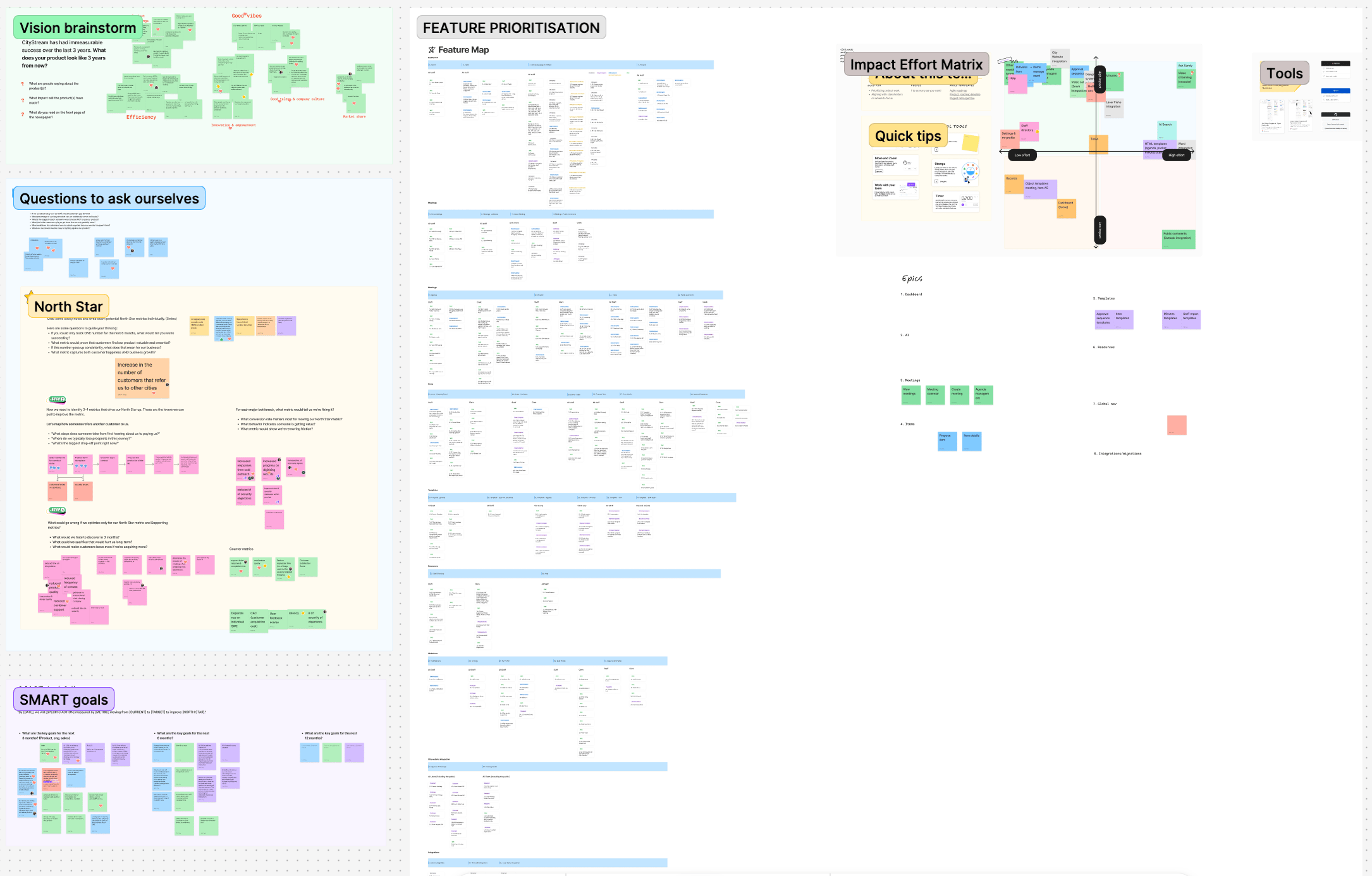
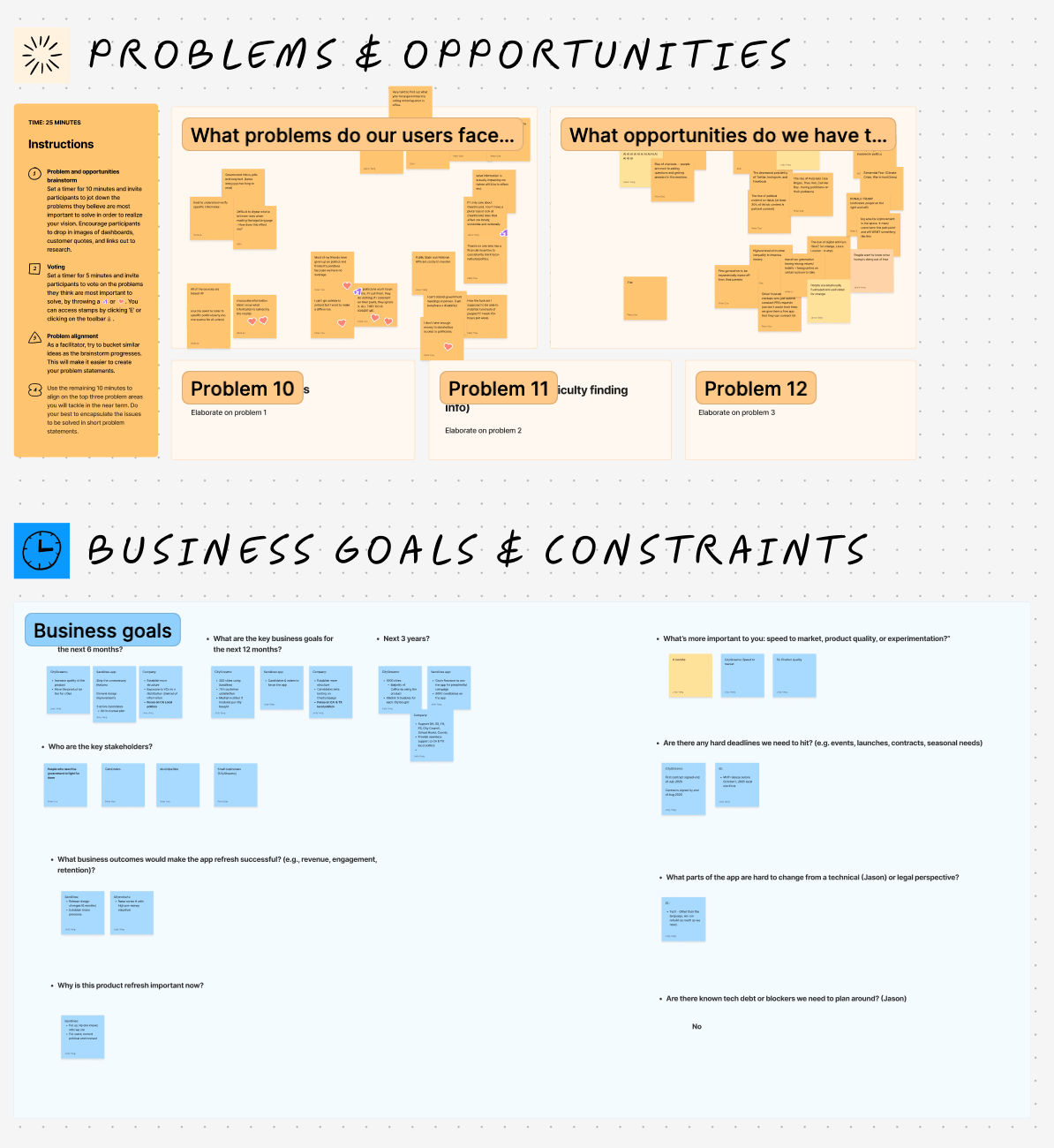
Alignment workshops I facilitated with the founders
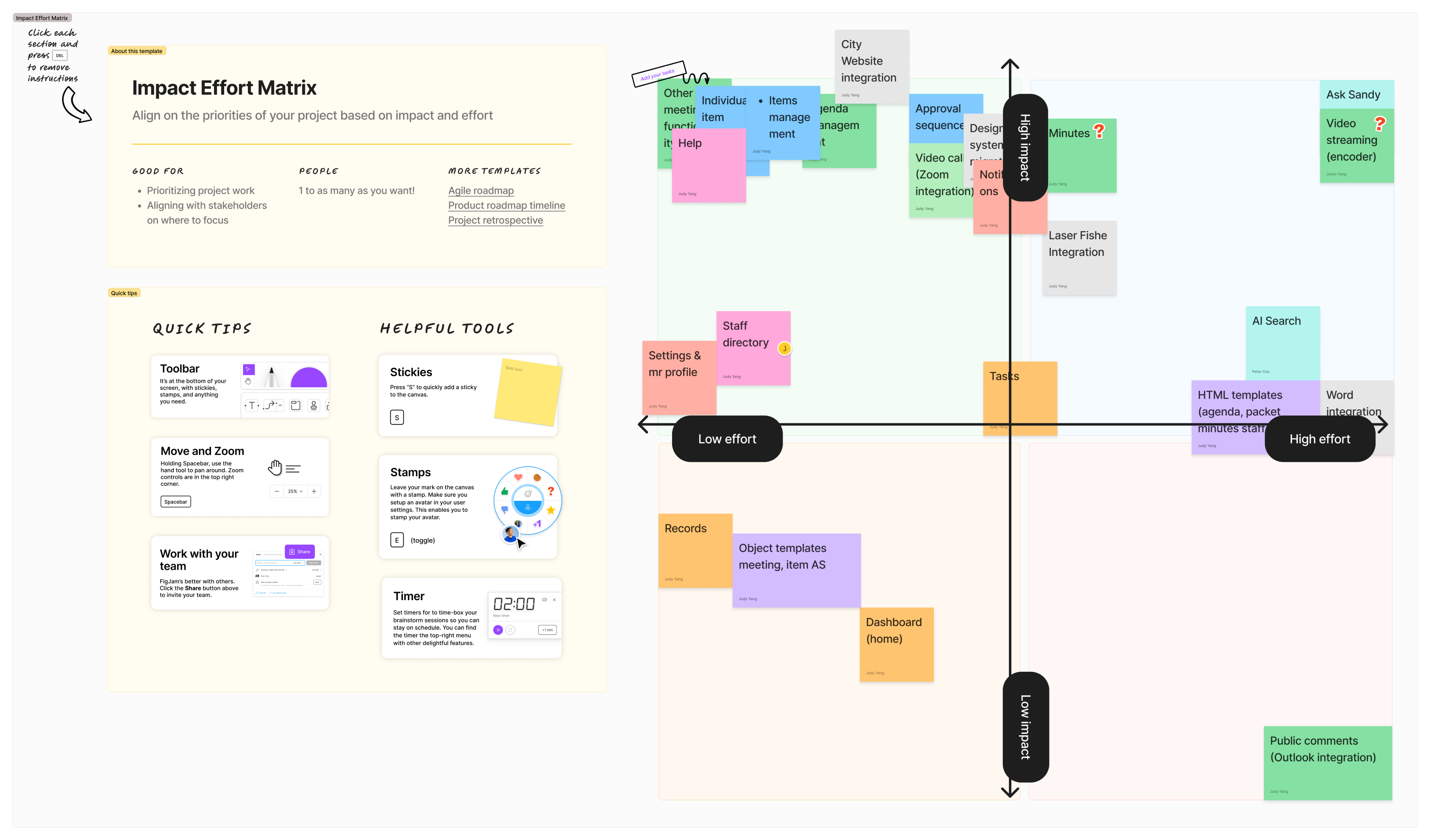
Impact Effort Matrix for feature prioritisation
The outcome: a massive pivot
The team would work on only 1 product, and the founders realised how inefficiently they were operating.
Everyone aligned on the problem to solve, short term & long term goals & the teams focus was severely narrowed. This also lead to the founders receiving the company’s 1st external funding.
This also lead to the founders receiving the company’s 1st external funding.
................
Step 2: Establish structure & product roadmap
Product development process
I created a product development process in collaboration with engineering.
I created a diagram to train the team on the ‘Why’ & outcomes of each step, but not follow the processes to a ‘T’, as per First Principles.
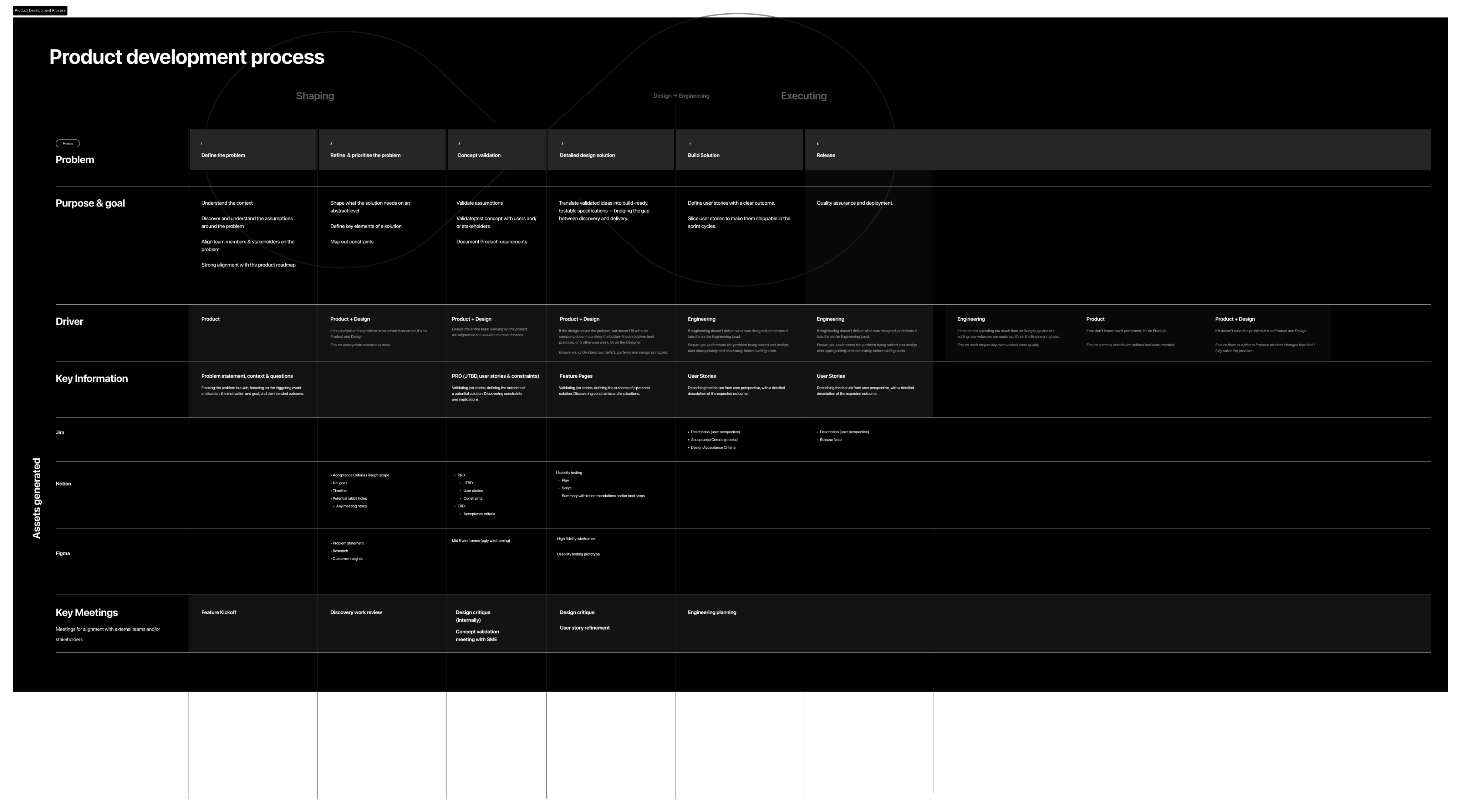
Product development process diagram for the product & engineering to follow.
Heuristic evaluation & product roadmap
Before creating a roadmap, I conducted a heuristic evaluation on the core features of the existing product, to see where the major usability issues are.
I used Nielsen & Norman Group’s 10 Usability Heuristics to conduct the evaluation.
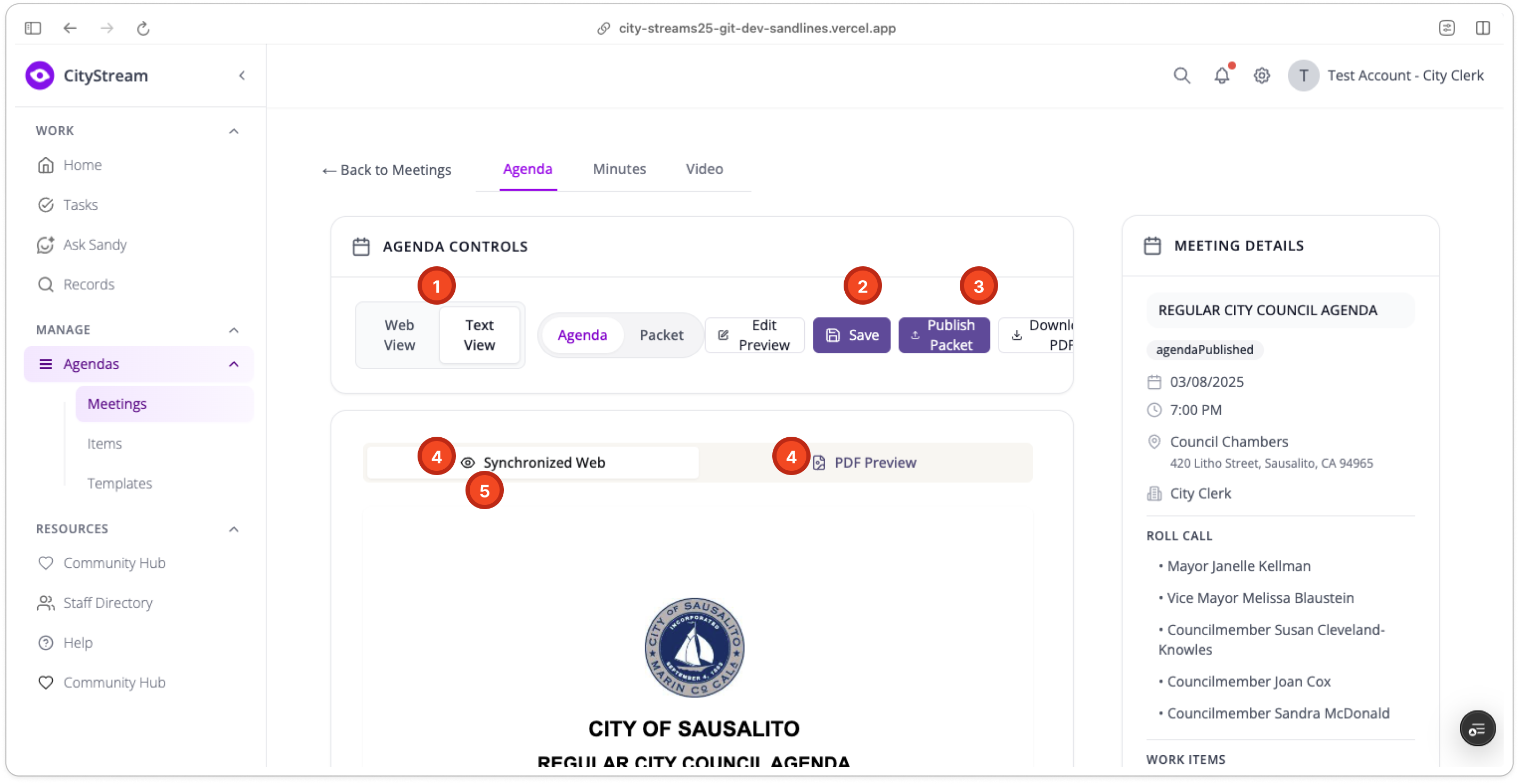
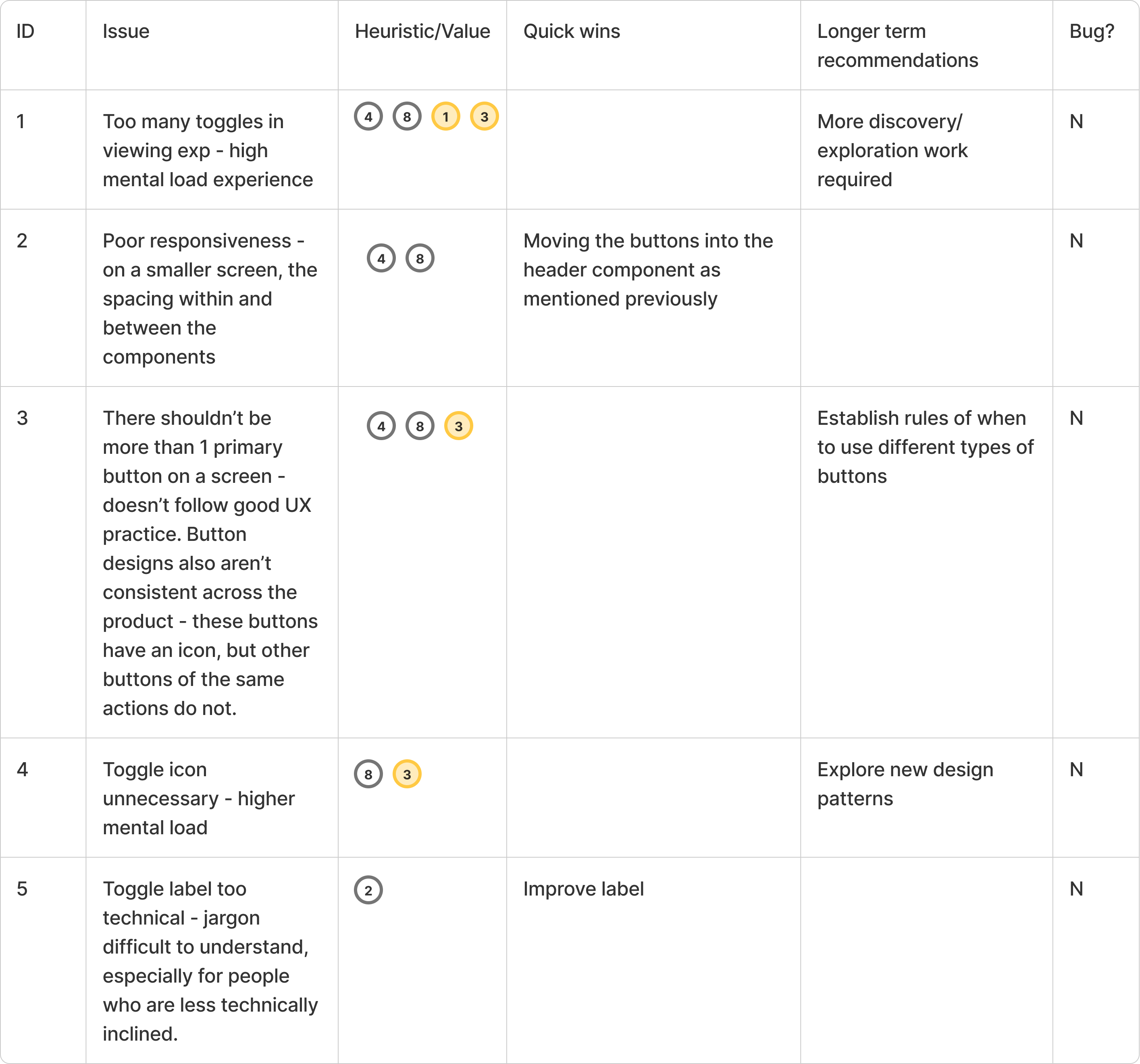
The Feature Mapping & Prioritisation workshop showed that the team has built a wide range of features.
I reviewed the insights with the Heuristic evaluation & asked the following questions, to decide on the roadmap.
- What are the core features of this product?
- What/how much value does this work contribute towards achieving business goals & product vision?
- What is blocking users from using our product?
- What are our assumptions?
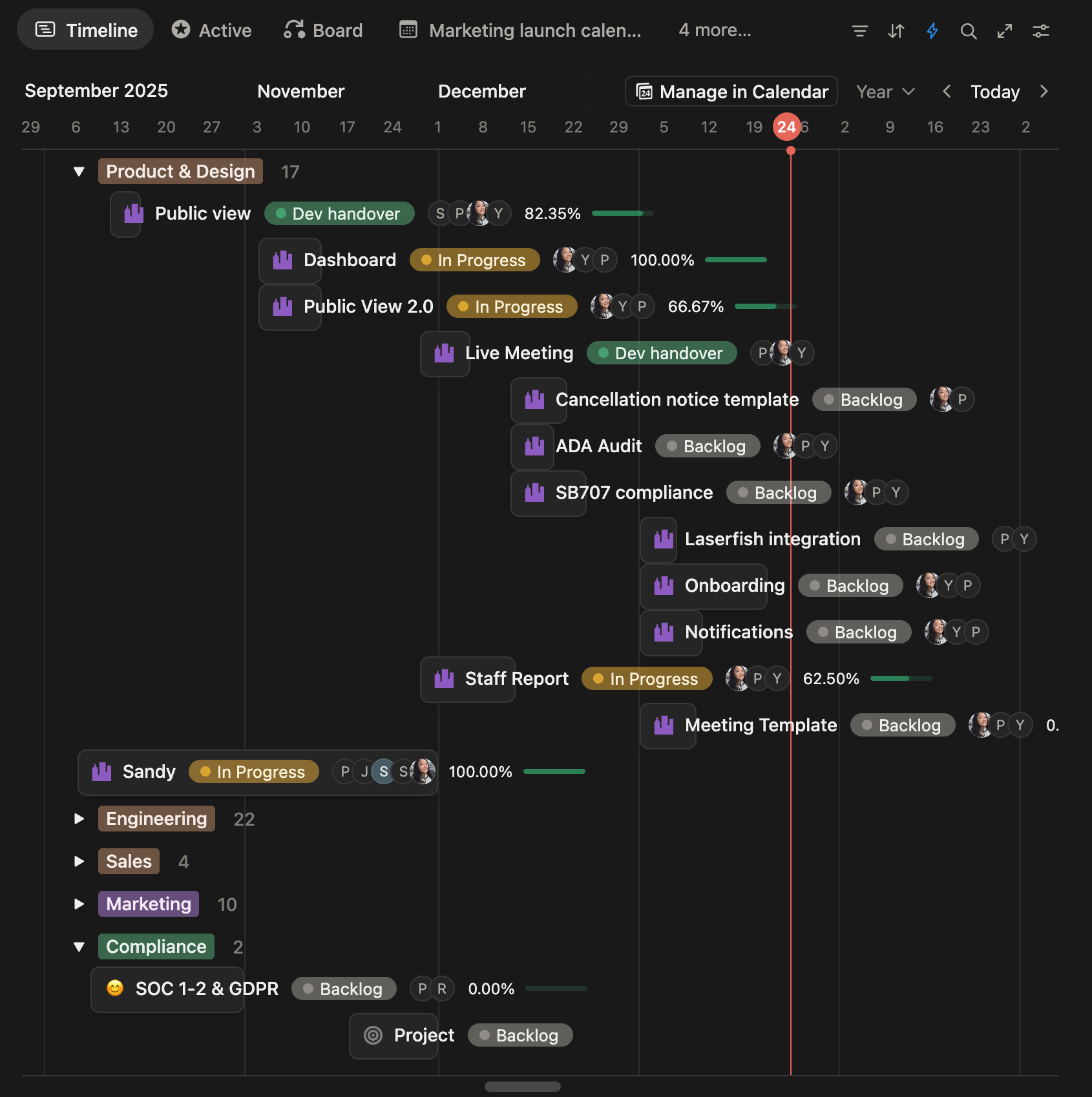
I then translated everything focused product roadmap, balancing impact, usability, and feasibility within the team’s available time and resources.
Design system
When I joined, there was no formal design system in place — engineers were working with Tailwind CSS and a set of custom-built components. After evaluating multiple design systems (MUI, shadcn/ui, Ant design & more) to determine the most suitable component foundation for the product.
I selected shadcn/ui for the following reasons:
- The product was already built on Tailwind, enabling smoother implementation and stronger design–engineering alignment
- More cost-effective compared to alternatives
- Component patterns were better suited to the product’s structure and complexity
- Highly customisable, allowing flexibility while establishing a consistent system
................
Step 3: Work on the product
Meetings/agenda management - IA & interface redesign
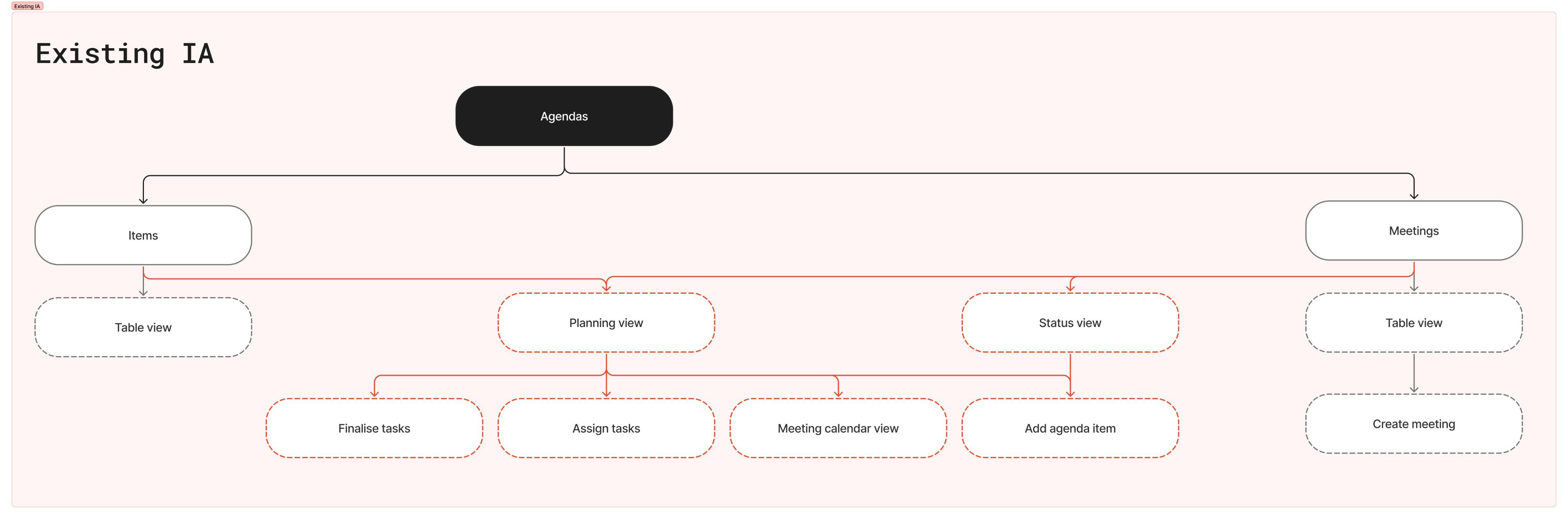
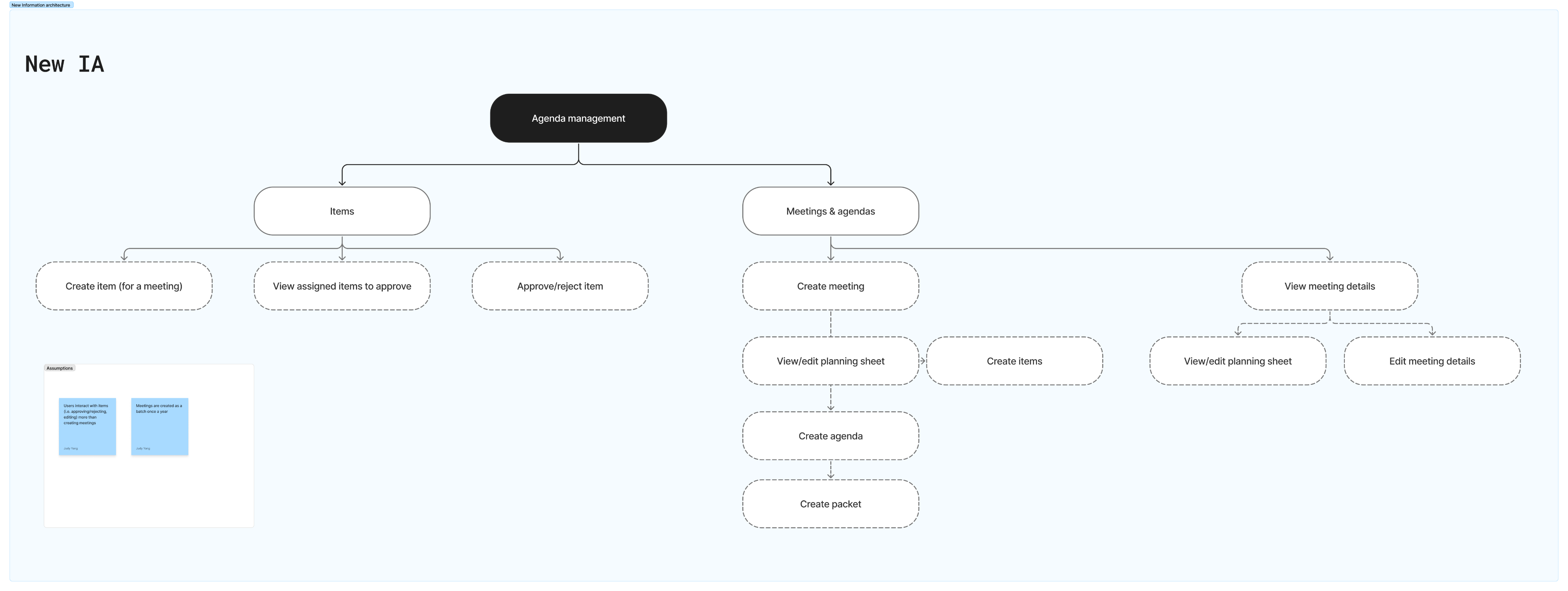
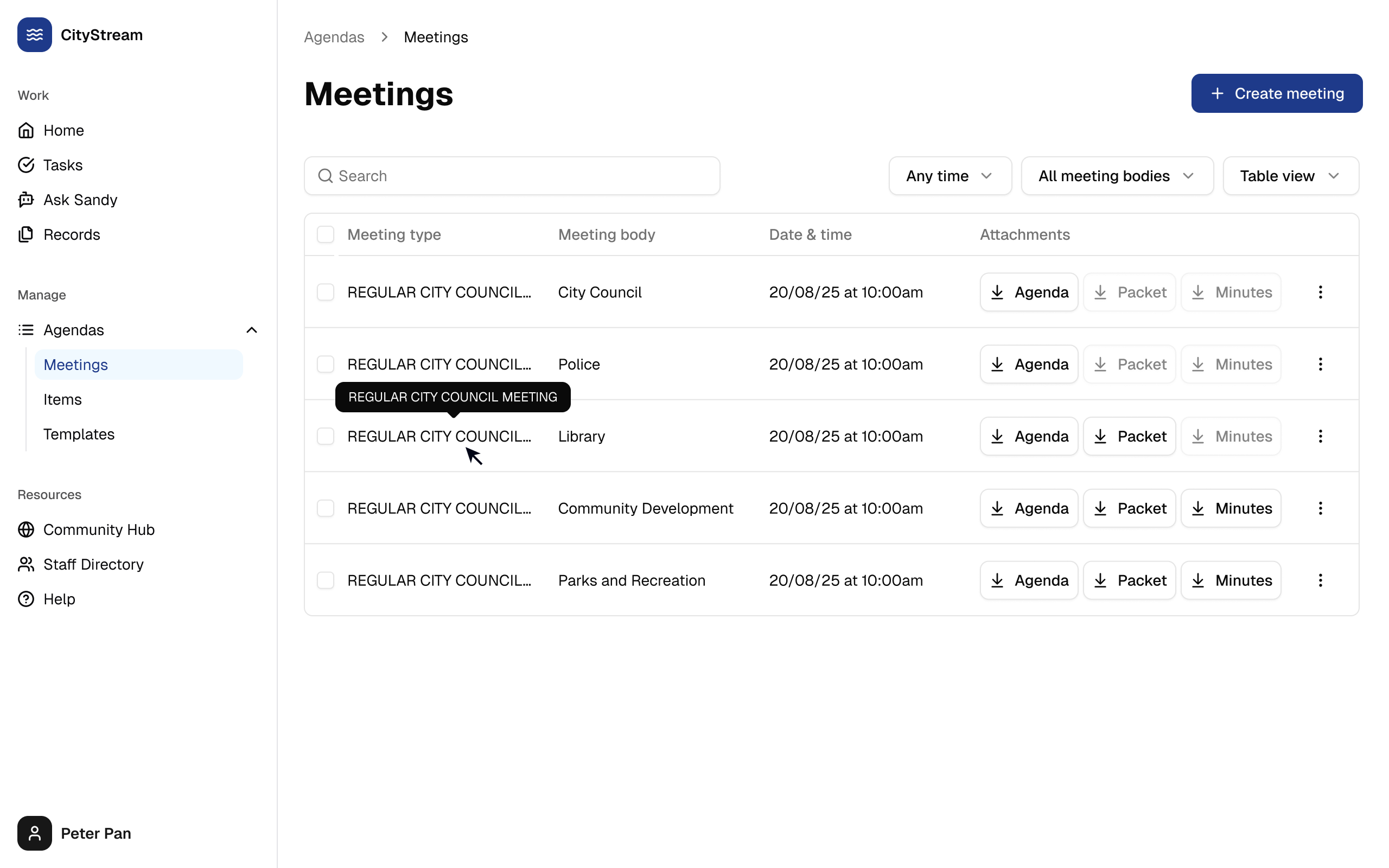
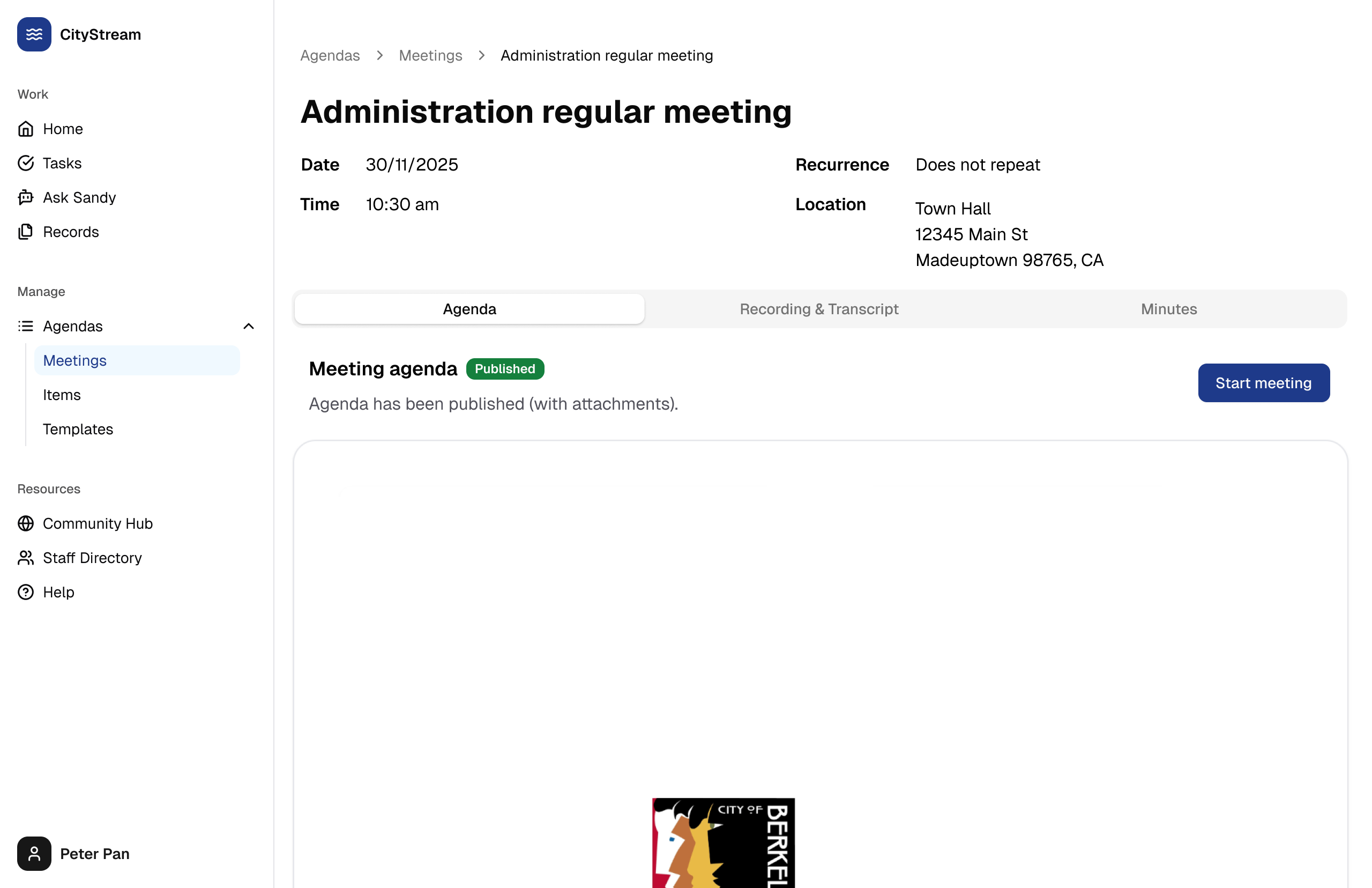
I also did a quick interface redesign of the view meetings & items to fix any low-hanging UX/UI issues, such as improving the visual hierarchy, creating a systematic colour scheme & ensuring WCAG 3.0 accessibility requirements are met.
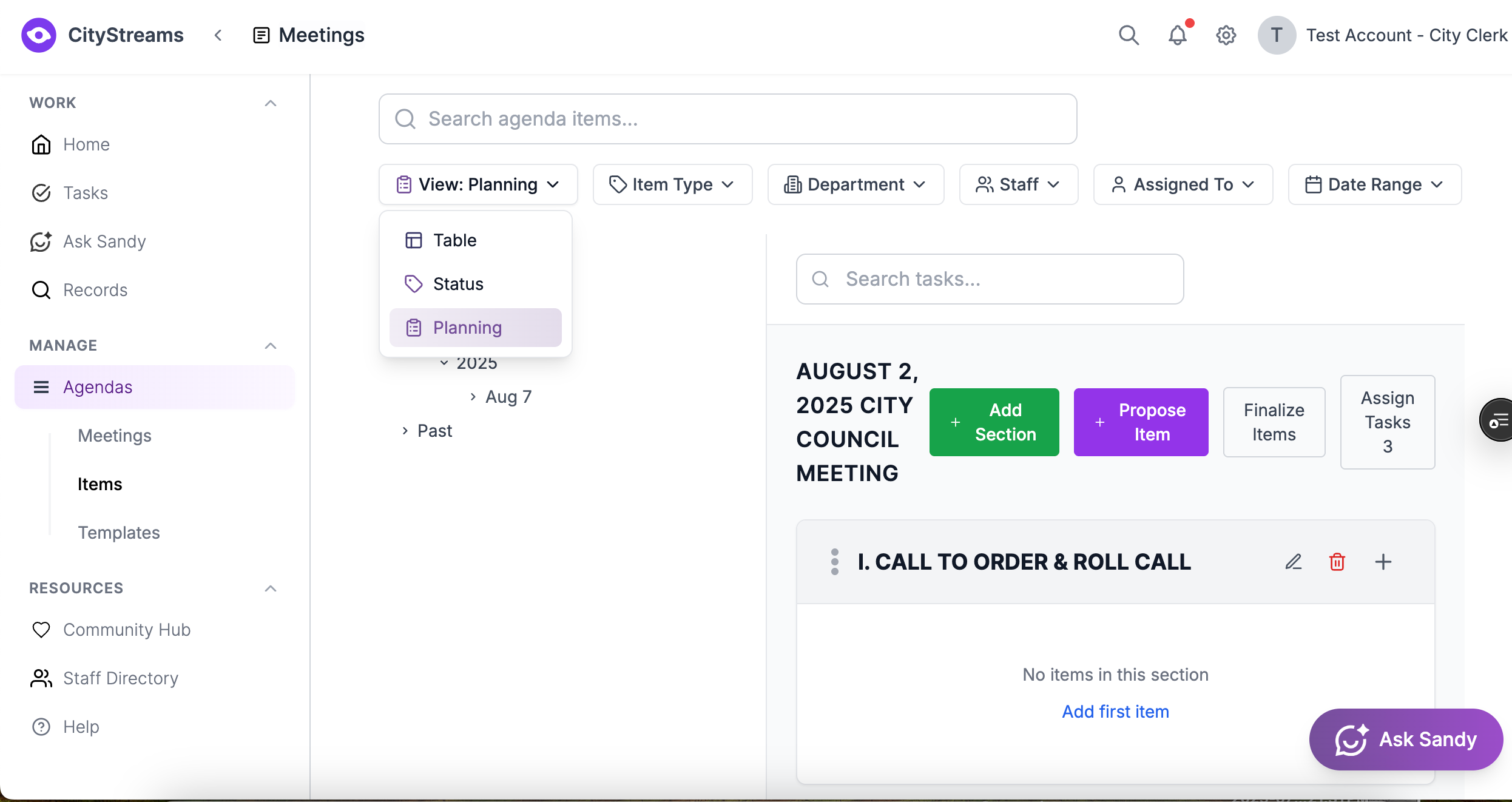
The heuristic evaluation revealed a major issue with the information architecture & navigation:
Different views within the agenda section jumped between different navigation items underneath ‘Agendas’.
Dashboard/task management
First principles approach
This project was initiated as a last-minute founder request with no additional time allocated in the roadmap and a 1 week deadline.
Using a first principles lens, I stepped back to define the core outcome, constraints, and assumptions rather than defaulting to our full discovery and PRD process.
Challenges & insights
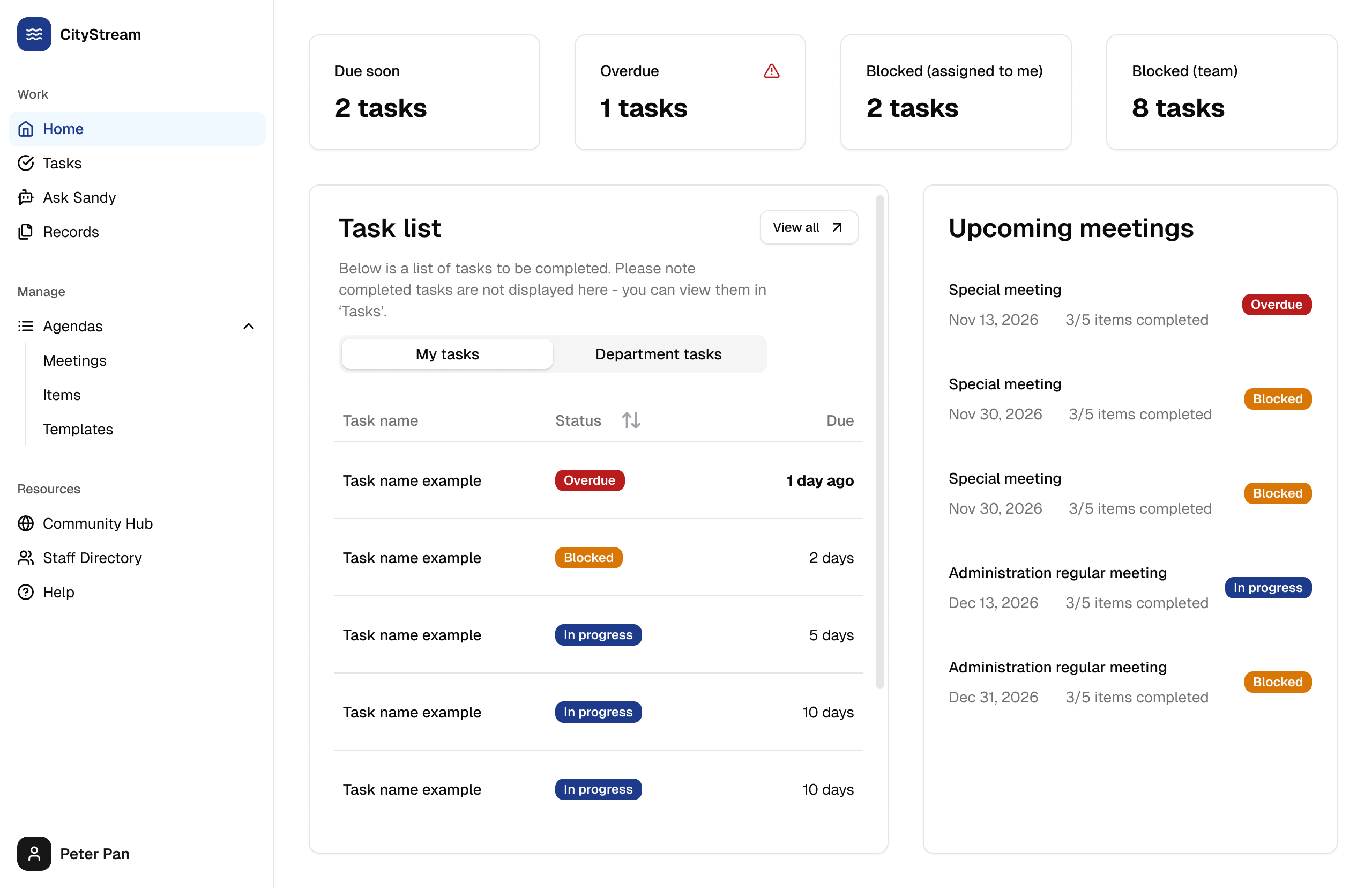
Although there was pressure to surface a wide range of data and functionality, I intentionally constrained the design to task management.
Prior user insights showed that difficulty tracking task status and due dates was a core usability issue, so the design focused on making task states, priority, and deadlines immediately legible to reduce cognitive load and improve day-to-day workflow clarity.
................
Key screens & Figma prototype
I implemented a slide-out modal pattern across the platform to support complex workflows & sub-tasks without disrupting the primary context.
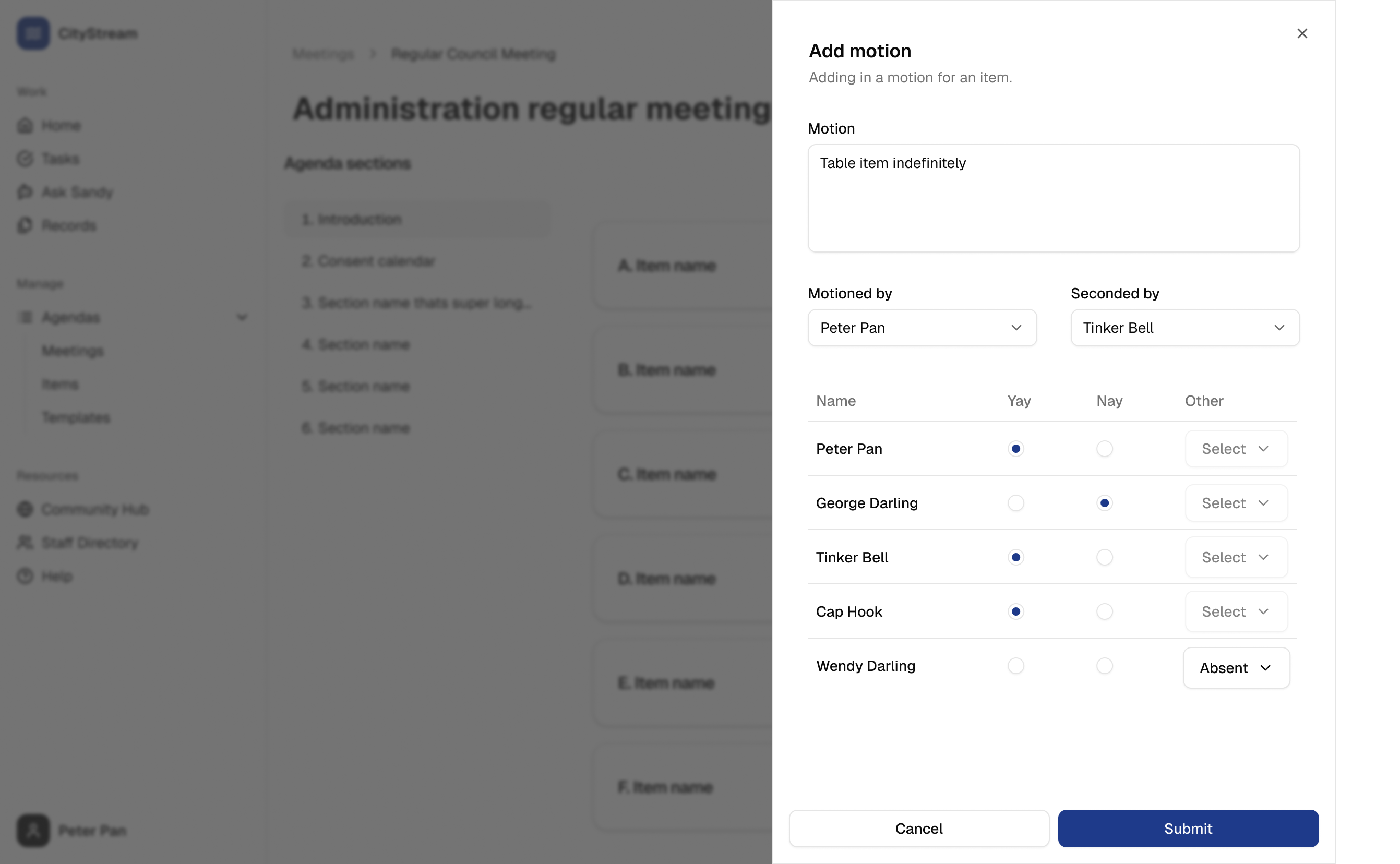
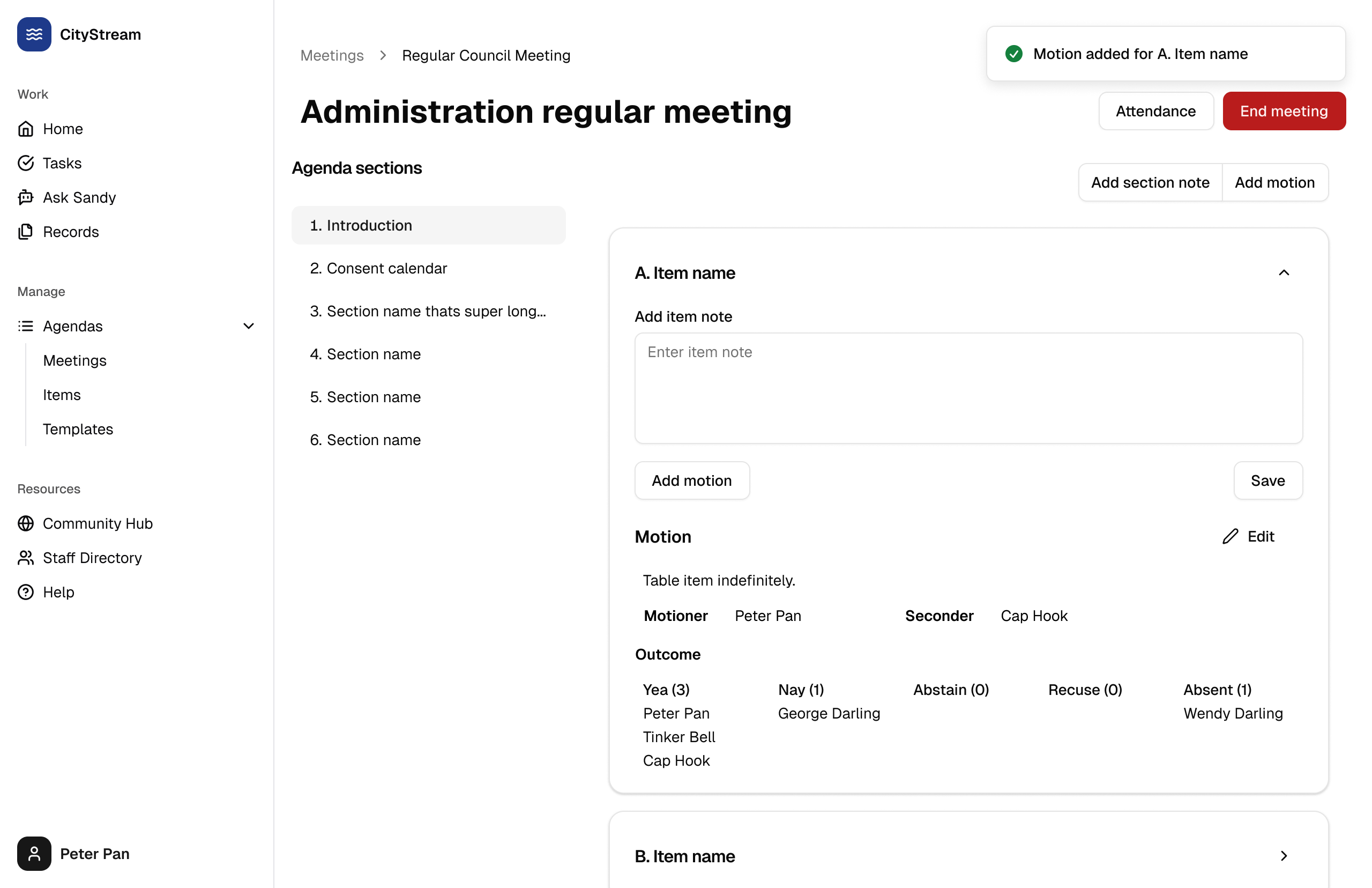
I used a secondary navigation in main screen in the Live Meeting experience for easy navigation.
This approach prioritize clarity, compliance, and real-time efficiency while maintaining contextual awareness,
Together, these patterns create a governance-focused interface that reduces errors, supports auditability, and streamlines high-pressure meeting workflows.
................
My learnings
Influencing decision-making in a founder-led environment
While I provided strategic guidance around prioritising product quality over short-term investor pressure, the founders’ inexperience sometimes made it difficult for those recommendations to land, i.e. allocating more resources for usability testing & more efficient feature prioritisation. This highlighted the limits of influence without formal decision authority and reinforced the importance of aligning on decision principles early.
Managing junior team dynamics
I underestimated the level of structure required to support junior designers and PMs around communication, ownership, and work ethic. I learned that clear expectations, tighter feedback loops, and more explicit accountability are essential when scaling team effectiveness.
................
View more projects:
Let’s be friends!
judyyang828@gmail.com
Mobile / Whatsapp: +61405437817


Home
Other projects
About me
CityStream - a Civic tech platform
Product & design strategy
·
Design lead
·
Product & design operations
Overview
- Pre-seed Bay Area start up
- Modernising local government administrative processes with meeting and agenda management.
As the most senior team member, I helped the leadership team break down the problem to solve, created alignment & established product & design processes and quality standards - all while working on creating solutions and moving the product forward.
................
Problems beyond the product
After I joined the team, I immediately felt confused on what I was told to work on, and why that was important.
On the surface, I noticed major issues such as:
- A small & inexperienced team working on 2-3 products, but not progressing in any
- A lot of re-working/going around in circles with existing features
- Over-promising & under-delivering, leading to rushed deadlines & poor quality build
................
First Principles
To get to the bottom of what was going on, I went back to First Principles & started asking the founders the following questions:
- What problems do the products solve?
- Why is this important?
- What is the business model?
- What value do the products each add to the business model?
Through the answers I received, it was clear that the team moved quickly to building their products without adequate planning or establishing a clear strategic foundation.
Internally, this resulted in misalignment of goals, mismanagement of resources, poor quality products/processes.
................
Step 1: Aligning the team
To resolve the identified issues, I first facilitated a few workshops with the founders to established aligned vision, goals & focus.
This included:
- establishing an aligned product vision, high-level business goals & constraints
- defining a North Star grounded in customer value
- translating everything into SMART goals
- introducing a feature prioritisation framework to guide trade-offs.
Alignment workshops I facilitated with the founders
Impact Effort Matrix for feature prioritisation
The outcome: a massive pivot
The founders realised how inefficiently they were operating, and how unrealistic their original goals were given the resources available. They also discovered that the problem they should be tackling is within the government administrative software space, which would allow the business to survive and thrive.
Everyone aligned on the problem to solve, short term & long term goals & the teams focus was severely narrowed.
This also lead to the founders receiving the company’s 1st external funding.
................
Step 2: Establish structure & product roadmap
Product development process
I created a product development process in collaboration with engineering.
I created a diagram to train the team on the ‘Why’ & outcomes of each step, but not follow the processes to a ‘T’, as per First Principles.
Product development process diagram for the product & engineering to follow.
Heuristic evaluation & product roadmap
Before creating a roadmap, I conducted a heuristic evaluation on the core features of the existing product, to see where the major usability issues are.
I used Nielsen & Norman Group’s 10 Usability Heuristics to conduct the evaluation.
The Feature Mapping & Prioritisation workshop showed that the team has built a wide range of features.
I reviewed the insights with the Heuristic evaluation & asked the following questions, to decide on the roadmap.
- What are the core features of this product?
- What/how much value does this work contribute towards achieving business goals & product vision?
- What is blocking users from using our product?
- What are our assumptions?
I then translated everything focused product roadmap, balancing impact, usability, and feasibility within the team’s available time and resources.
Establish a design system
When I joined, there was no formal design system in place — engineers were working with Tailwind CSS and a set of custom-built components. After evaluating multiple design systems (MUI, shadcn/ui, Ant design & more) to determine the most suitable component foundation for the product.
I selected shadcn/ui for the following reasons:
- The product was already built on Tailwind, enabling smoother implementation and stronger design–engineering alignment
- More cost-effective compared to alternatives
- Component patterns were better suited to the product’s structure and complexity
- Highly customisable, allowing flexibility while establishing a consistent system
................
Step 3: Work on the product
Meetings/agenda management - IA & interface redesign
The heuristic evaluation revealed many major issues, i.e. different views within the agenda section jumped between different navigation items underneath ‘Agendas’.
As there was no time allocated to fix this ‘properly’, I did a speedy IA redesign (see below), to streamline the experience.
I also did a quick interface redesign of the view meetings & meeting details pages to fix any low-hanging UX/UI issues, such as improving the visual hierarchy, creating a systematic colour scheme & ensuring WCAG 3.0 accessibility requirements are met.
Dashboard/task management
First principles approach
This project was initiated as a last-minute founder request with no additional time allocated in the roadmap and a 1 week deadline.
Using a first principles lens, I stepped back to define the core outcome, constraints, and assumptions rather than defaulting to our full discovery and PRD process.
Challenges & insights
Although there was pressure to surface a wide range of data and functionality, I intentionally constrained the design to task management.
Prior user insights showed that difficulty tracking task status and due dates was a core usability issue, so the design focused on making task states, priority, and deadlines immediately legible to reduce cognitive load and improve day-to-day workflow clarity.
Live Meeting Management
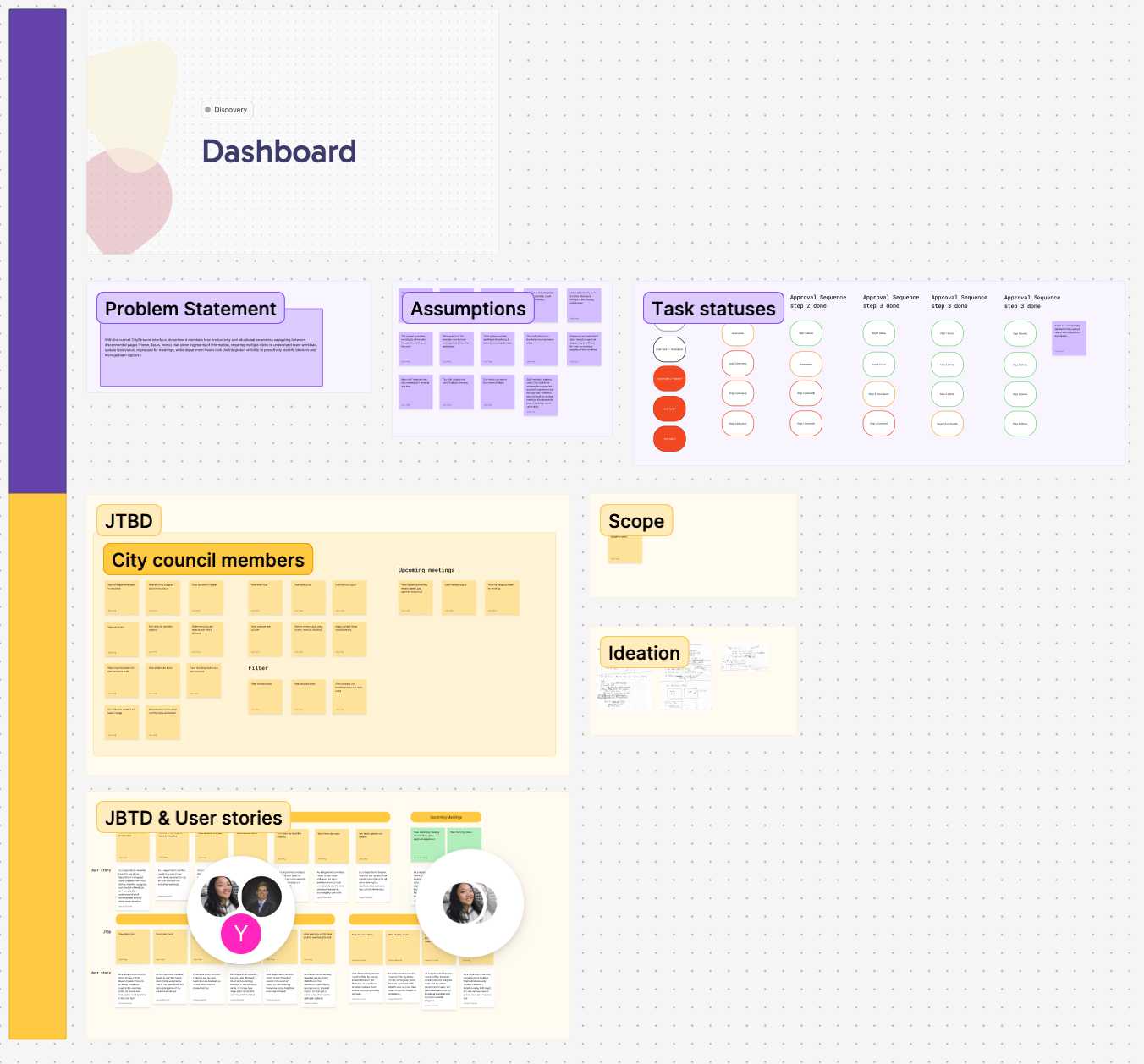
Live Meeting Management experience needed to be designed for council employees to be able to use CityStream as a siloed product for meeting & agenda management. These meetings are usually conducted in person, the feature will need to be able to integrated with live-streaming & display management softwares.
Product discovery
First Principles was my guiding star in approaching product discovery & design. I used core questions (listed below) to figure out what needed to be done.
Core questions
- What is the core job-to-be-done?
- What functionality is already built? How does the new feature fit into the current product
- What is legally required to be conducted within a live meeting?
→
Activities
- User interview
- Research legal requirements
- Map meeting motions process
- Map recusal process
- Service design blueprint (incl. technical integrations with multiple softwares)
- JTBD & User stories
- User flows
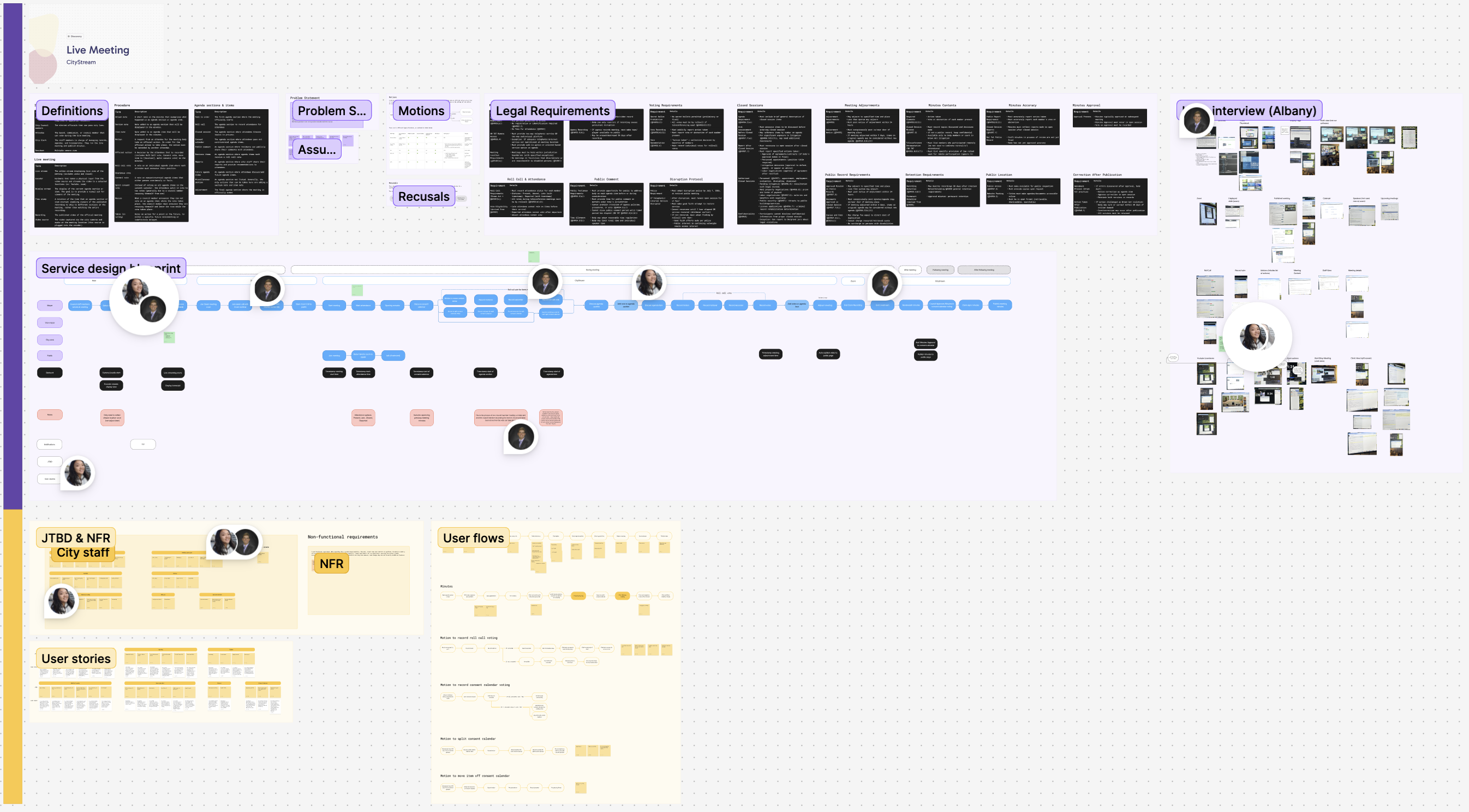
Live meeting feature - discovery board.
Usability testing
We only had 1 participant who was able to take part in usability testing, however the feedback we got from her were overwhelmingly positive. See below for some quotes:
“That was so simple.. SO much better than Granicus... There’s so much unnecessary stuff on the Granicus interface... but this is very clean.”
“Oh my gosh...this would make my life so much easier... You have no idea how long we normally spend doing that [chasing people up with approval sequence reminders]!”
................
Key screens & Figma prototype
I implemented a slide-out modal pattern across the platform to support complex workflows & sub-tasks without disrupting the primary context.
I used a secondary navigation in main screen in the Live Meeting experience for easy navigation.
This approach prioritizes clarity, compliance, and real-time efficiency while maintaining contextual awareness,
Together, these patterns create a governance-focused interface that reduces errors & streamlines high-pressure meeting workflows.
................
My impact
- Led the product strategy, establishing a clear and realistic direction aligned with business goals and stakeholder priorities
- Improved overall product quality, strengthening CityStream’s differentiation in a competitive market
- Elevated and streamlined product and design processes, increasing team efficiency and delivery consistency
................
My learnings
Influencing decision-making in a founder-led environment
While I provided strategic guidance around prioritising product quality over short-term investor pressure, the founders’ inexperience sometimes made it difficult for those recommendations to land. This highlighted the limits of influence without formal decision authority & the importance of aligning on decision principles early.
Managing junior team dynamics
I underestimated the level of structure required to support junior designers and PMs around communication, ownership, and work ethic. I learned that clear expectations, tighter feedback loops, and more explicit accountability are essential when scaling team effectiveness.
................
View more projects:
Let’s be friends!
judyyang828@gmail.com
Mobile / Whatsapp: +61405437817